

Suburbanasia
The environment younger Millennials and older Gen-Z grew up in withered away their ability to mitigate stress and handle disagreements. Is there any way to fix it?

There’s a supermajority when it comes to the type of world which young people want. Almost all of us claim to want the world to be radically different. Most of us find the work of making it different pointless against the broad opposition of the status-quo preservationists, or the gerontocracy, or otherwise underpaid, or just flat-out unbearable. I’m probably an outlier, where unlike reactionaries, I don’t think the root of young people wanting the world to change is easily explained by weakness (coddling) or hypocrisy. Very clearly, it’s the measurable output of a system that has been running like this for more than thirty years, and the way out is probably geographic-economic and ambitional before it’s anything else.
The system I’m talking about has four pillars: the geography of 1990s suburbia, the labor-market script that told us to follow our passion, the parenting protocol that optimized us for legibility to credentialed institutions, and the credentialing machine itself. Raised inside it, many of us unceremoniously arrived at adulthood missing a specific capacity — the procedural skill of acting on a world that is generally behaving like it is not pleased with us. The Hugbox is a type of anaesthetic that prevents people from generally going totally apeshit. It is what gets built when there is nowhere else to be and nothing larger to do. My belief, derived from niche construction theory (Odling-Smee, Laland & Feldman, Niche Construction: The Neglected Process in Evolution, Princeton 2003) is that this is definitely compounding the problem and almost solidifying that future generations will have even less to lose — without an attitude that shifts towards constructivism, The Hugbox will become another decayed institution suffering from both rot and scaling issues.
How We Hurt Ourselves
The 1990s were the most aggressively expansive suburban decade in American history. Here are some statistics: Brookings’s exurban analysis found the typical exurban tract had 14 acres of land per home against 0.8 in inner suburbs. By 2005, exurban counties were growing 12% per five years, faster than any other settlement tier. Median new home size rose from 1,905 to 2,521 square feet between 1990 and 2007 while household size shrank to 2.59 persons. Gated communities went from 4% to 16% of new builds; by 2001, an estimated seven million U.S. households lived behind walls. The dwelling enlarged. The household shrank. The perimeter hardened. And despite what you’re probably told by generations committed to avoiding admitting specific mistakes, the largest metropolitan area by population in America was only getting radically safer after years of instability and decay.
The suburbs, and subsequent speculative interest, completely eliminated the third place — it became impossible for young people to find a place to spend time proximally with each other unless their parents were able to afford placing them in a gated community full of other kids their age (even this failed rather quickly, more on this later). Single-use zoning basically made the café, the corner store, the unmonitored loitering space structurally illegal in residential neighborhoods. A child raised in this geography had, until sixteen or older, two destinations: home and the institution to which a parent drove them. The demand for complete and total privacy of studying the suburbs to correctly diagnose these problems hides it from view, and limits the amount of groundtruth we have for even addressing this problem, so bear with me here. British longitudinal data is the cleanest available — in 1971, 80% of 7- and 8-year-olds walked to school alone; by 2010, under 7%. And get this! It wasn’t because more young people were getting access to driving — in fact, the opposite occurred: American driver’s license data tracks the same step-change where 16-year-old licensure fell from 46% in 1983 to 24% by 2014. The car was the postwar canonical exit from parental supervision. For some reason, either structural or cultural artifacts of the suburbs ensured that exiting parental supervision was delayed by a decade. Some people never made it out at all.
Here’s some examples of what that took from many young people:
friction with an unsupervised stranger,
negotiation with an indifferent shopkeeper,
a long unauthorized walk through a neighborhood where nothing was your parents’,
hurting yourself in a construction zone,
finding out that the real world is never actually under control of any one group of people, especially not your parents, no matter who they are (yes, even if you are the Walton’s).
These are some examples of random events, and generally speaking, how any organism learns it can act on a world it does not control. The 1990s were the first time in modern history an entire cohort completed adolescence without it. Nowadays, the results of suburbanization have eroded the spaces between enclaves so badly that small risks like these can’t be taken without incurring bigger risks (like getting shot, which is increasingly and ironically more likely-per-capita to happen to you the more remote you tend to go).
Mantra
On top of the geography lies a mantra: do what you love, and you will be happy. Marsha Sinetar’s 1989 self-help bestseller was the popular vector; Steve Jobs’s 2005 Stanford address married it to the nascent ideology of Silicon Valley, the world’s premier Hugbox substrate factory. “The only way to do great work is to love what you do.” Jobs himself did not follow his passion; unlike myself, he stumbled into electronics commercially and then fell in love with it when he realized he was really, really, really, really good with them. The advice was retrojected onto his biography, kind of like in all the movies they make about Freddy Mercury always having that scene where he comes up with the entire instrumentation of Bohemian Rhapsody in his bedroom in 11 minutes.*
*I don’t know if this is true. I haven’t watched any of them. The last music biopic I watched was the fake Weird Al one on Roku, it made me quit my job several few years ago like the day after I saw it.
Everyone talks about the pipeline of what kids in the suburbs (and probably elsewhere) where “supposed” to do: good grades, honors classes, extracurriculars, SAT prep, admissions consulting, acceptance to a good college, major in something just get a degree, (failure point started here, the rest of the list is more recent) unpaid internship, first credentialed job, DON’T FUCKING FREELANCE, continuous self-investment, eventually the house in the better suburb. Big house. Apartment is failure, it’s for divorced dads, and it’s ontologically bad to us, but it’s also the only thing you can really afford so like, I don’t know, maybe just go fuck yourself? The output of this system, Deresiewicz wrote, was “smart and talented and driven, yes, but also anxious, timid, and lost… great at what they’re doing but with no idea why they’re doing it.” Erin Cech’s longitudinal data in The Trouble with Passion scored it empirically: passion-driven career choosers end up in lower-paying, less stable jobs than peers who chose for security. The passion principle, she concluded, is a cultural mechanism for the reproduction of economic inequality. Tokumitsu in Jacobin named it the “secret handshake of the privileged”.
Almost everything about this broke in exactly 2008. The leading-edge cohort had completed many of the early steps and was arriving at “first credentialed job” at the moment the entry-level market cratered. Wage scarring from graduating into recession persists ten to fifteen years. Recent-graduate underemployment has stayed between 39% and 45% since 2010; humanities and social-sciences graduates cluster near 55%. The cohort that enterted the loop did not get the loop’s payoff, and was never told what to do if the script failed (it never contained any sort of contingency plan, which probably contributed to the skyrocketing amount of fatal overdoses within this population group). The only response the loop had to its own failure was its reiteration: try harder, retrain, “learn to code”, follow your passion again.
Psychology
The empirical record on this cohort’s psychology is unusually… clean.
WHAT IS YOUR LOCUS OF CONTROL?
Locus of control is a psychological concept referring to the degree to which individuals believe they control the events and outcomes of their lives, as opposed to external forces beyond their influence. First proposed by psychologist Julian Rotter in 1954, it acts as a spectrum measuring an individual's personal agency.
Twenge, Zhang, and Im’s 2004 meta-analysis of locus of control across four decades pooled 97 college samples and 41 child samples. Locus of control became more external — toward “outcomes are determined by forces outside my action” — by approximately 0.80 standard deviations between the early 1960s and 2002. The average college student in 2002 had a more external locus of control than 80% of college students in the early 1960s. The construct survives the major methodological objection to Twenge’s broader program. Externality correlates with poor school achievement, helplessness, ineffective stress management, decreased self-control, and depression.
I have a good supporting example here from a classic scientific tale. Curt Richter’s 1957 study found that rats briefly rescued from water tanks swam for 60 hours compared to the 15-minute baseline of, demonstrating that perceived hope drastically increases endurance. A more internal locus of control probably compounds agency; a more external locus of control probably reduces it. You can think of this as navigating a decision tree:
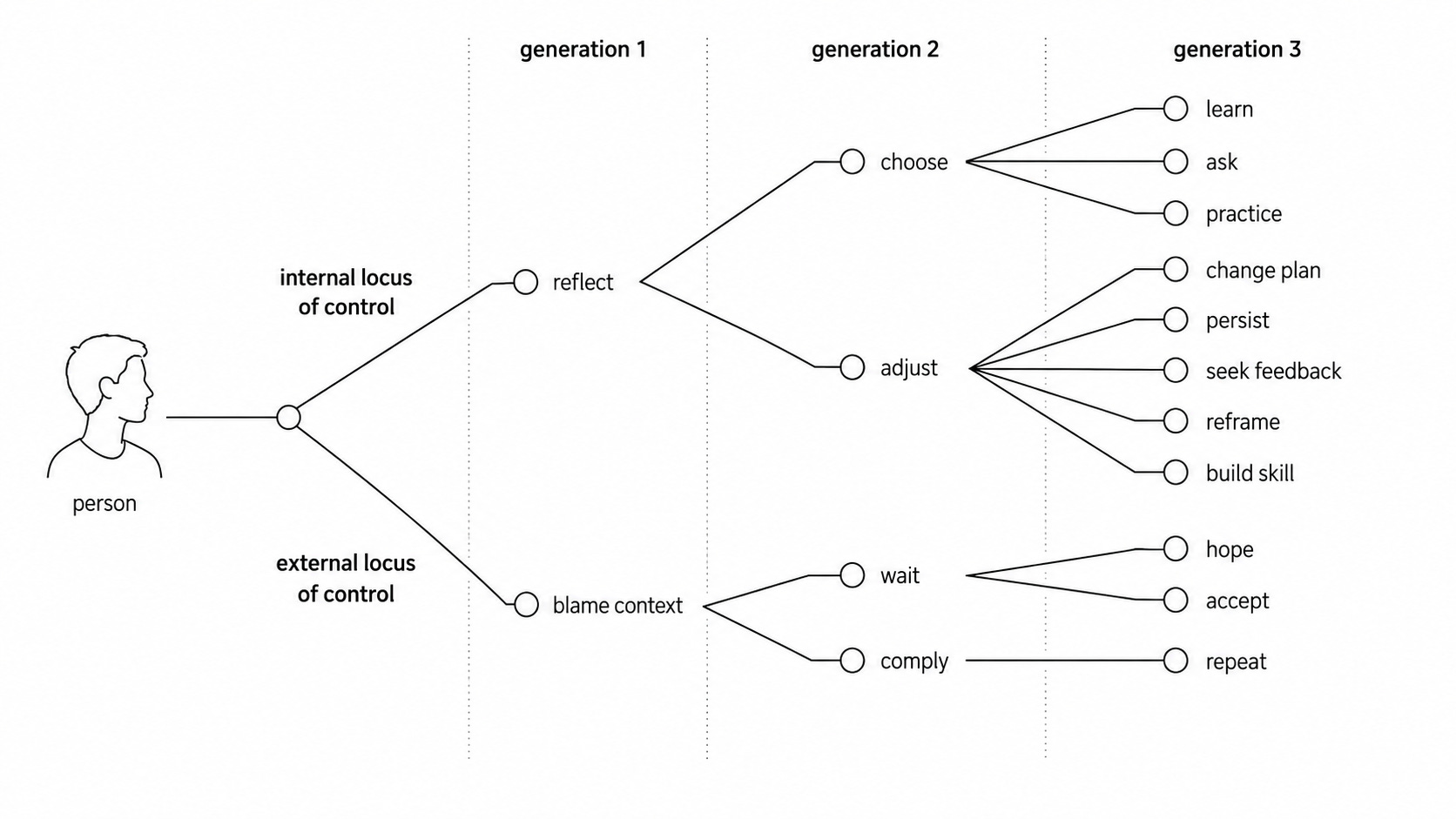
Peter Gray’s 2011 paper states it plainly: children who do not have the opportunity to control their own actions, to follow through on their own decisions, to solve their own problems, grow up feeling they are not in control of their lives. I think this makes total sense. Locus of control is not an innate quality. It is learned through recursive confrontation with problems which an adult or parent cannot solve for you. The cohort never had this experience because the adults were always there. The adults were always there because they incorrectly diagnosed the bad random events which happened to them as preventable with more surveillance, instead of realizing that a society constructed within the bounds of parental surveillance were good at completely destroying the ability for the next generation to maintain and expand the infrastructure required for prosperity. Who experiences a higher number of bad random events in a day: someone living in Johannesburg, or someone living in Brooklyn?
I’ll give it the benefit of the doubt and say helicopter parenting mostly came from good intentions (the counterfactual: it also came from a desire to control children, downstream of some parents’ own realization that they couldn’t control the bad things that would eventually happen to their children, ironically creating circumstances where even more bad things happened). But there’s increasing amounts of research, neither supplanted by the “culture war” nor broadcast at all by the gerontocracy’s media arm (cable television, legacy publications) which indicates the damage it did. Doepke and Zilibotti’s macro-explanation is the cleanest: intensive parenting rose sharply in high-inequality societies but not in low-inequality Scandinavia (or even places worse off economically with surprisingly equal wealth distributions: Slovakia and Slovenia). As returns to skill rose, parental investment in legibility-to-credential-machines rose with them. The economically rational response of a high-inequality society’s parents was to optimize their child for the machine. The model overfit on past data and ended up cannibalizing itself. A 2024 meta-analysis found that “interference with the development of agency appears to undermine psychological development in a myriad of important ways.” Career adaptability, self-efficacy, resilience: all atrophied. The attempts to optimize and guide children too far into adulthood completely killed their optionality and agency. Now we have an even bigger problem: adults who want to get out of the economically dead cities they grew up in can’t even afford a bus/train/plane ticket and a month’s rent in a new city. They are sucked into the gravity well of a black hole that will eventually kill them, one way or another. It’d take years for them to be able to get out and the longer that time goes on, the harder it gets. Roots get put down. Dreams die. And then there’s the question of if they still have helicopter parents, who by this age likely are in the demographic of currently or imminently needing care. How on earth do you expect people to have kids in an environment where they may still internally feel like one?
People like this were not crushed into passivity. Many were never given the conditions in which the alternative could develop. It doesn’t matter how much money were thrown at these people (up to a level, which is the level of “people who have the choice of never working”, which is not part of the middle distribution I’m analyzing. These are outliers). They were simply missing affordances.
The Missing Affordances
The four-component system doesn’t really explain well why our response to its failure took the form it did. Earlier cohorts under comparable distress organized differently. The 1930s American left produced widespread labor militancy. The 1960s American left produced communes, the Catholic Worker, and SDS field offices in Mississippi. The reactionary move here is to attribute the difference to character or values (avoids analysis) — they were tougher than us, we are softer than them. That move is wrong.
The Infrastructure. Was. Entirely. Different.
The 1930s organizer had a union hall, a working-class neighborhood dense enough to leaflet on foot, a movement press at neighborhood scale, intact fraternal organizations, and an economy where six months of paid organizing could be lived on for a year of savings, eventually an automat, increasingly abundant housing. I live in one of these units today. I’m writing this article from a place this hypothetical person’s hypothetical parents lived and raised them in. The 1960s organizer had cheap rent in major cities, intact university communities, draft-resistance networks with operational discipline, a national civil-rights movement actively training cadres, and a still-extant labor movement to apprentice into. This is what I argue were affordances — physical, financial, institutional — supplied by the surrounding society to anyone who wanted to act in pursuit of a better life.
We have almost none of them. I’d argue NYC has the most of them in America in the smallest amount of space. For the rest of you: the union hall is gone. The working-class neighborhood is gone, it’s priced into the exurb. The movement press is gone, replaced by an algorithmic feed which is different for everyone and optimized by Silicon Valley (to no fault of its own, but downstream of the desire for endless growth detached from infrastructure) to produce the largest substrate containing infinite Hugboxes. Cheap rent in major cities is completely gone unless you want to be exit liquidity for gerontocrats. Six months of organizing on savings is unavailable to a cohort with median net worth 34% below cohort-age expectation. Apprenticeship into existing movements is unavailable because the existing movements have been hollowed or many of the people in power don’t actually have any skills to transmit to you and mostly got to where they are from a variant combination of lying, male brute-force, Looking Good! and trickery.
It’s time for everyone who just personally related to that paragraph’s favorite philosopher: Fisher called it reflexive impotence. The subject knows things are bad but can’t act, they’re totally paralyzed! Thus, the subject treats the incapacity as a fact about the world rather than about its own missing tools. Locus of control goes extremely external and overshoots the ability to take action with a wider set of options. Han’s complementary diagnosis: we are no longer disciplined from without but exploit ourselves from within. “The complaint of the depressive individual, ‘Nothing is possible,’ can only occur in a society that thinks, ‘Nothing is impossible.’” The “Can” of the positive imperative was internalized; when the imperative failed, the failure registered as internal. Berlant named the third movement cruel optimism — attachment to a routine that is itself the obstacle to surviving the routine’s failure.
Lilliana Mason’s distinction between expressive and instrumental political behavior is relevant to contextualize this lane of thinking. Expressive behavior signals identity, but instrumental behavior changes outcomes. We tilt heavily toward expressive behaviors, not from a lack of will but because the infrastructure for instrumental work has decayed below the threshold at which a normal or average person can apprentice into it. To make matters worse, Hugboxes are designed to reward expressive behavior (you are now an influencer) and punish instrumental behavior (you are engaging in platform manipulation).
The first round of hugboxes, prior to the New Internet, were increasingly policed communities largely pushed to become “safer” by recursively increasing policing, generally by their wealthiest or oldest members. It’s funny when you put it that way, because it sounds like a lot of the insular & “ingroup”-focused online communities, which is partially why they are marked for death*.
*(To existing readers of Vectorculture, yes, this is foreshadowing Vectorculture’s “What Kills Internet Communities, Part II”)
Sometimes, for fun, I think of things like a political scientist instead of an engineer-philosopher. It really makes me feel like the degree I have in it is worth $0 instead of $-135,000. I would compare the popularity of Hugboxes, downstream of the effects of suburbanization (isolated from close proximity to others your age), as a power vacuum being filled by the only remaining internal-locus Millennials trying to replace decaying infra with new infra: the Tech Bros.
The Worst Part
Here's the best part: none of this is necessary. At this point, we’re literally doing this for no reason. The cohort is, at this point, just responding semi-accurately (and increasingly incoherently) to brutal material conditions, while a small group of high-agency individuals achieve outsized influence, capital, and power, worsening the issue but turning the sights cleanly on each other as everyone gets ready to blow each others’ heads smoove off. The 2008 crisis hit at the early subgroup’s labor-market entry moment. Real wages for college-educated males 25–34 declined from 2000 to 2014. Student debt rose from $480B to $1.6T. Under-35 homeownership fell from 43.6% to 36.5%. This was over a decade ago, and now our measurements aren’t even close to consistent because that institution decayed too! Locus of control externality is a natural and rational accuracy about a world that was, in fact, beyond control. And today, that’s an understatement: it is pure chaos now. The Hugbox is a rational form of harm reduction. I understand why it exists. But we may reach a point where it stops working, and that’s very unlikely to reduce entropy of the overlying system.
Most of this is right. Petersen’s Can’t Even and Harris’s Kids These Days document the damage accurately. The cohort did not imagine its dispossession. It didn’t see any of this coming while at the same time having their ability to deal with black swans removed from their option table. But economic damage alone doesn’t explain the form of the response. Comparable damage produced different forms in other cohorts.
The American 1930s, Argentine 2001, Greek 2010, Chilean 2019, Hong Kong 2014–2019 — cohorts under severe material pressure that organized militantly, tolerated police violence, produced general strikes. The variable missing from the economic-determinist account is the developmental capacity to tolerate the friction such organizing requires, and that capacity is precisely what the four-legged apparatus failed to produce. What Marxists would argue is the class of the petit bourgeoisie aren’t failing to organize because organizing is inherently irrational (note: past the continuation of SV implementing a digital hyper-surveillance state, it might end up being, unless you want to organize a business and gain leverage over that system). Here’s the thing. Young Suburboids are failing, that’s just what’s happening. Young Suburboids aren’t failing because the prerequisites weren’t part of their upbringing. Economic damage is necessary to the explanation, but it’s not the full picture.
The Hugbox
The pattern is most legible at the microcultural tier, and the analytic point worth making is that it is not ideologically located. It shows up on the left in the DSA-adjacent online scene’s chronic editorial drama and the conversion of clinical language into a social weapon, as documented inside the tradition by Frost and Reed, and across the broader therapy-speak phenomenon described by Fishbein and Waldman. It shows up in the postrationalist scene — workshops, retreats, vibes-curated lists that work for early-phase agency-building until they hit the natural limit of any container without sufficient external mooring, at which point the container almost always reorganizes itself around elders rather than changing its operating rules, like a fucked up sort of HOA. It shows up on the right in a Sneako chat, a paid looksmaxxing Discord, in purposefully-hidden sonnenrads that find their way into TikTok videos. The individual pockets of the gated trad influencer ecosystem, replying to Howling Mutant with a variation of his username like showing up to Church with a Jesus fish sticker on the back of your car, or any sufficiently “based” tribune with its own internal affect codes and social norms. One could even argue that Dimes Square itself is a type of Hugbox, although I’m not sure if these days it refers to really anything in this city.
At the mesocultural tier, the pattern is the PMC millennial’s everyday environment (which is currently in a controlled demolition by the Tech Bros): NGO sector, university administration (where non-faculty roles inflated from rough parity with faculty in 1980 to nearly 2:1 by 2014), corporate “people operations”, “trust and safety”, “Corporate America” — the roles into which the credential machine traditionally routed surplus output, which then optimized for procedural correctness in the absence of any sort of instrumentalization.
At the macrocultural tier, the pattern is residue or even broader abstractions of the other layers: content warnings on streaming, corporate etiquette in Slack and Discord, sensitive-content filters, “ban X” and “deplatform” as the dominant mode of political expression on both wings.
The Hugbox is a non-ideological metaformative concept. It is a formal property of an under-tooled cohort’s relation to discomfort, and it is reconstructed wherever the cohort lands, under whatever aesthetics happen to be locally or network-available. This is the foundation that leads us into how we fix it: the solution will either be incomprehensible to the current political/ideological dichotomy, or it will exist within our outside both sides of the current, or the entire political dichotomy is about to shift: one side with low agency and an external locus of control, the other with high agency and an internal locus of control.
Moveset
There is no political program in this essay, no movement to join, no candidate to vote for. Sorry to those of you who wanted me to play sports. The conditions that produced the cohort can’t be unraised retroactively. No agenda will retroactively give us the developmental affordances Millennial-and-beyond generations were denied. What can be done is more immediate and harder, and it comes down to two moves.
The first is geographic. I’m going to be real with you. Fucking leave the suburbs. Move to the largest urban core proximal to where you came from — not “move to San Francisco” if you’re from Cleveland, but the densest concentration of capital and people you can reach without severing yourself from the network you already have.
Actually, I’m lying. In America, you most likely have to get to San Fransisco or New York City if you want to be part of the solution and not a passenger watching their home slowly turn into something you don’t understand that — if we’re being real — probably won’t benefit you unless you’re on the other side of it entirely (and this will be hard to manage from where you are).
The empirical argument for this is straightforward and is best made by working from the premise that the United States is, as a functioning system, historically capitalist and currently hypercapitalist. In a capitalist system, the opportunities that actually move a trajectory — not the incremental raise but the introduction that becomes the job, the side project that becomes a company, the conversation that becomes a coalition — distribute according to a power law. Most never come. Some never experience any. The ones that do, come where capital and ambition concentrate physically. More volume = more chances = more shots. Bettencourt, Lobo, Helbing, Kühnert and West’s 2007 PNAS paper established the underlying scaling: wages, patents, R&D employment, and what the authors called “supercreative” employment all scale with city population superlinearly, at roughly the 1.15 power. Doubling a city’s population produces about 15% more of these outputs per capita. The same scaling shows up in venture deployment — the top three U.S. metros have for years captured something close to three-quarters of all U.S. VC dollars.
This is what power-scaling means. It is not that bigger cities are nicer, sometimes they’re not. It’s that the ambient density of opportunities for asymmetric gain — the kind of gain that resets the slope of your life, a 5x, a 10x, a 20x, rather than incrementally improving its level by 1.15x — is non-linear with location. It’s exponential with location. The suburb is structurally near the floor of the distribution. The mid-sized city has some signal. The metro core has orders of magnitude more. To remain in the suburb past your mid-twenties is to accept, in effect, that your career-and-life lottery tickets will arrive at the rate the suburb supplies them, which is approximately zero. Soon, it will turn negative. You are right to be concerned about the Datacenters: they are a way to get value which was leaked from urban cores back into the densest financial cores in the country. You will watch your city become West Virginia.
The objection that the city is expensive and brutal is totally correct and doesn’t change the analysis. The cost of living in the metro is the price of the option. The option is the only thing that pays out asymmetrically. The salaried suburban life feels stable because it has eliminated both downside and upside, and the trade for that elimination is the slow attenuation Section IV described. To refuse the trade is to commit to a higher-variance life in exchange for being where the upside actually lives.
The second move is harder, and personally I don’t think this is an option I would take (I definitely have tried):
Abandon the middle-tier ambition of “a career that pays enough for me to actuall live and also makes me happy.”
That ambition is the case that risks sadness — it’s what the routine told you to optimize for, and now you have to choose to do the opposite, which will be gutting. It is also directly in the crosshairs of the Agentic Memeplex. The personal-fulfillment frame produces moderately credentialed, moderately compensated, moderately satisfied lives, which is the tier the American economy has been ruthlessly hollowing out for forty years. There is no stable middle to ambitionally inhabit. The viable plays are at the tails: be very good at a trade, do something extremely unique which can get you employed in a very small but stable space (beware!) which the cohort has been systematically discouraged from, and which is materially better than the broken script for many of the people now trapped in it; or aim for participation in historical collective affectation — the kind of work done at a scale beyond one’s own life, by groups of people, with a chance of mattering historically, and that one lets oneself be marked by, or otherwise has a permanent demand that scales with any sized population (study at a local college and become a nurse at the nearest hospital, which in most states is the #1 employer).
By historical collective affectation I mean this pretty broadly: being part of a scene, a research program, a company, a political coalition, an artistic milieu, a movement — anything that operates at a scale larger than personal fulfillment and that has a non-trivial probability of leaving a mark on the period. This is the older and harder ambition. It probably won’t pay the bills, which is fine if you’re okay with that. The personal-happiness frame can’t accommodate it. The historical-affectation frame absorbs personal happiness as a byproduct or doesn’t, and either way the project continues. This option is basically “become a passenger, reify the idea that your locus of control is external by surrendering control to people like Alex Karp, and wish for the best” which is why I don’t recommend it for you if you have the slightest inclination that you want to fight with people like that for the power to build something better.
Both moves, however, dissolve the conditions of the Hugbox automatically. You can’t maintain a carefully curated discourse enclosure in a city where every block contains a different scene or type of person. You cannot optimize for psychological safety while committing to collective work whose timeline is longer than your career. The hugbox was an under-tooled response to the conditions of the suburb plus the broken middle-tier expansion loop. Change the conditions and the Hugbox loses its function without replicating the Hugbox in the first place.
None of this requires waiting for institutional reform, political victory, technological breakthrough, or anyone else’s permission. It requires staying with a friend or partner for a while with 2 suitcases full of your most critical stuff, and revising the working theory of what a life is for. The first is logistically annoying, the second is harder than anything in this essay. Both are immediately available, and there is no version of the cohort’s situation in which a critical mass making both moves does not measurably change the cohort’s near-term trajectory.
Now again, I strongly recommend Move 1, but I’m biased. I live in Manhattan. Time just moves faster here. And if you want help making that move, please feel free to reach out to me. It was the best decision I ever made.